A newly published Disney patent application describes technology that could turn the smoke left behind by a fireworks show into a show of its own. The filing, titled “Opportunistic Projection Onto Dynamic Light Reflective Material,” describes a system that projects dynamic images onto changing surfaces like smoke, fog, mist and low-lying clouds, and even fireworks residue, tracking the surface in real time as it drifts, splits and dissipates. Reporter Scott Gustin flagged it on the morning of August 20, 2026, the day it published.
A Second Show Hiding In The Smoke
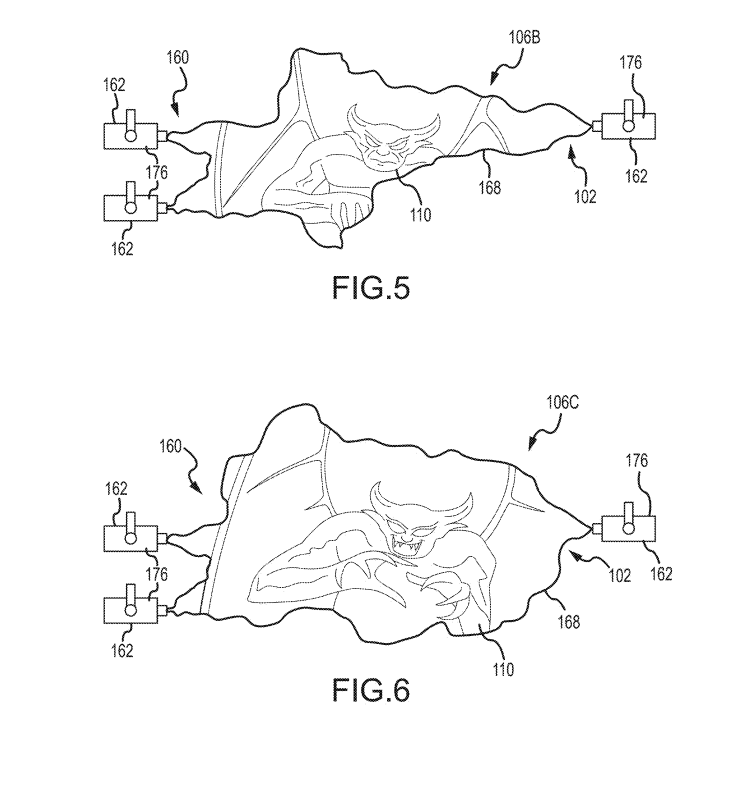
The examples in the filing are the fun part. Gustin highlights a few: using post-fireworks smoke for a “second show,” characters that split apart when a smoke cloud divides, and separate images that merge into one as clouds combine. Because the projection surface is constantly moving and changing shape, the system continuously maps it so the imagery stays coherent on something that never holds still. Cameras and a nonvisible light source detect the size, shape, density and position of whatever material happens to be floating there, and a controller reshapes the content to fit it.
Chernabog And Madame Leota Are In The Drawings
The illustrations attached to the filing are unusually suggestive for a patent document. One figure shows Chernabog projected onto a cloud of smoke, demonstrating how the image would hold together as the surface shifts. Another shows Madame Leota’s face, which reads as a fairly direct hint that a disembodied head floating in haze is on somebody’s whiteboard. Whether either ever leaves the page is a separate question, but Disney chose those two characters to explain the idea, and both belong to properties currently in active development in the parks.
Thirty Years Of Fighting Smoke, Now A Reason To Keep It
There is a genuine irony here. Disney spent decades engineering smoke out of its nighttime spectaculars. The company’s precision fireworks patent granted in 1994 replaced black powder launches with compressed air specifically to cut smoke and pollution, a system Disneyland debuted in 2004 and Disney offered to license out through a nonprofit. Two decades later, the company is exploring a reason to keep the smoke around, treating the leftover haze as a canvas instead of a nuisance.
It also extends a clear recent pattern in Disney’s projection research. A separate Imagineering filing published in June describes a pop-up projection surface that extends into cones and funnels and then vanishes when the effect ends, and earlier patents cover projecting onto moving performers and simulating virtual worlds on real architecture. The through line is projection mapping on surfaces that refuse to sit still.
This is a published application rather than a granted patent. It entered the public record on August 20, 2026, having been filed in February 2025, and publication is a procedural milestone rather than an approval. Companies file far more ideas than they ever build, and a published application is not an announcement. But Disney’s nighttime entertainment is in an inventive stretch, and its parks are deep in an Imagineering era defined by new show technology. If any company has both the fireworks and the incentive to make the smoke perform, it is this one.
For the latest news and updates make sure to follow us on social media! Facebook | Twitter | Threads | Instagram | TikTok