
Walt Disney World can now run entirely on solar power during sunny daytime hours. That is not a future goal or a press release promise. It is real, it is operational, and it has been a long time coming.
The announcement dropped in April 2026, timed to Earth Day, but the story behind it stretches back nearly 50 years. Understanding where Disney started with solar makes the current milestone feel less like a corporate headline and more like the payoff of a very long bet.
It Started With a Hotel in 1978
Long before solar panels became a standard sustainability talking point, Disney was already experimenting. In 1978, the Disneyland Hotel’s Bonita Tower became the first hotel building in the United States to use a solar water heating system. That is not a footnote. That is a genuinely early move for a major company.
The next significant step came in 1982, right as EPCOT Center was opening. Disney installed 2,200 photovoltaic panels on the roof of the Universe of Energy pavilion. The attraction, which centered on the story of energy itself, was actually powered in part by the sun above it. The theming and the technology lined up in a way that felt intentional, because it was.
For years, those installations sat as quiet proof of concept while the rest of the industry caught up.
The Hidden Mickey That Changed Everything
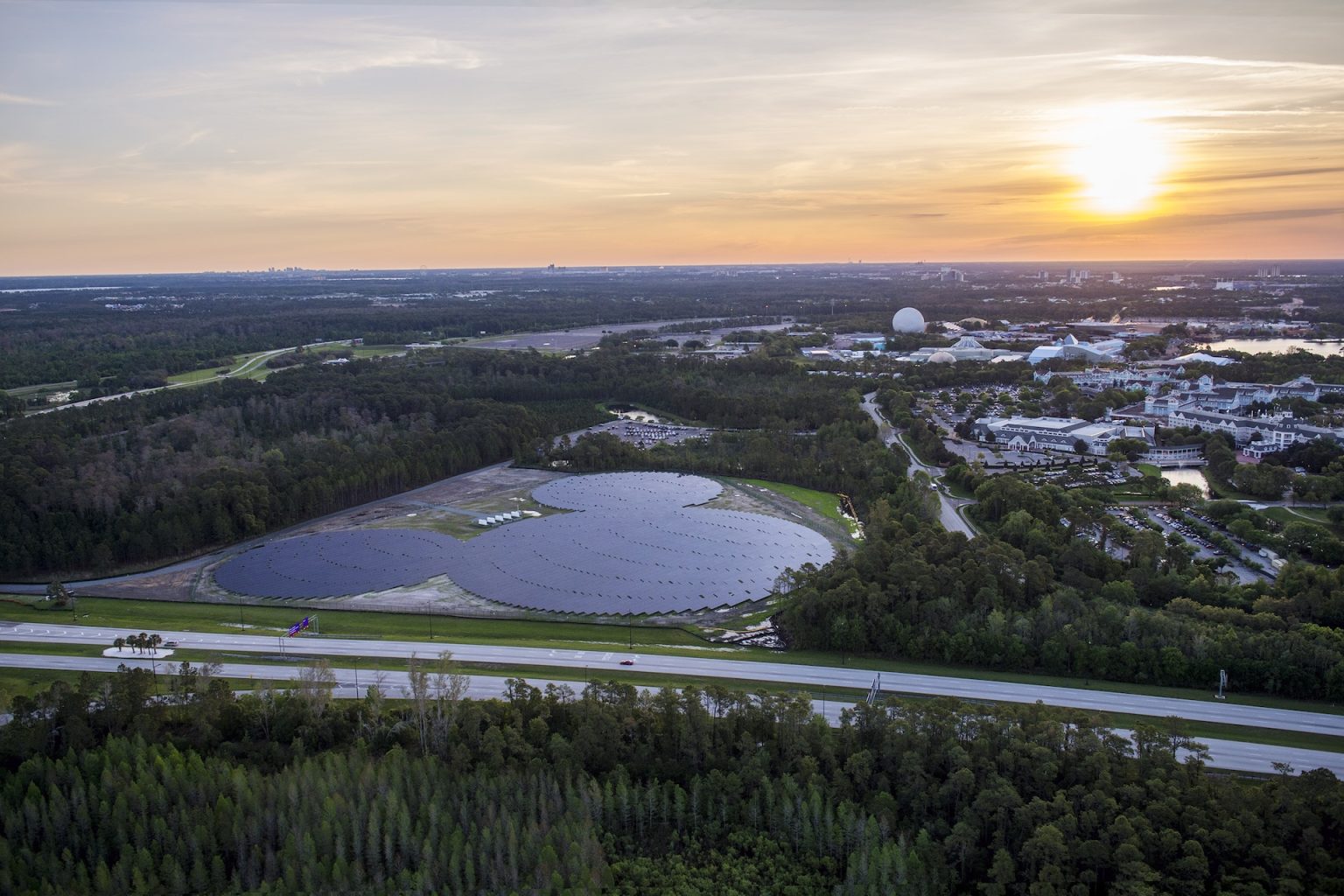
The real turning point came in April 2016, when Disney and Duke Energy unveiled what quickly became one of the most talked-about solar projects in the country. On 22 acres of land near EPCOT, crews had arranged 48,000 solar panels in the unmistakable shape of Mickey Mouse’s silhouette.
Technically, it was a 5-megawatt facility capable of powering roughly 1,000 residential homes. Practically, it became a landmark in Disney’s sustainability story because people could see it from above and immediately connect it to the brand.
The project was a partnership between Duke Energy and the Reedy Creek Improvement District, the governing body that managed Walt Disney World’s land at the time. Disney bought the power the array generated, funneling it back into resort operations. It was clever on every level: useful, visible, and very on-brand.
Blog Mickey covered that 2016 unveiling and has been tracking Disney’s solar expansion since. You can read their full breakdown of the most recent announcement over at Blog Mickey.
The 50-Megawatt Leap
The Hidden Mickey array was impressive, but it was a proof of concept compared to what came next. In 2018, Disney announced a partnership with Reedy Creek and solar developer Origis Energy USA to build a facility ten times more powerful than the Hidden Mickey farm.
That project brought 500,000 solar panels online and pushed Walt Disney World’s capacity toward powering two of its four theme parks during peak production. It was a workhorse project, without the visual charm of the Mickey shape, but the numbers were staggering.
By this point, Disney had quietly become one of the largest corporate consumers of solar energy in Florida. The infrastructure was growing in ways that made a full-resort solar goal look less like ambition and more like math.
The Fourth Facility and the Full-Resort Milestone
The piece that completed the picture came in April 2026. A new 74,500-kilowatt facility on 484 acres in Levy County, Florida came online, built and operated by Bronson Solar in collaboration with the Central Florida Tourism Oversight District, the body that replaced Reedy Creek after Florida’s legislative changes in 2023.
At 484 acres, the site spans roughly the equivalent of 366 football fields. Together, the four facilities now give Walt Disney World over 600,000 solar panels total.
Because of that fourth facility, on a sunny spring or summer day, those panels can now generate enough electricity to cover 100% of the resort’s daytime power needs. That covers all four theme parks, two water parks, more than 20 themed hotels, hundreds of restaurants, and the transportation network that connects all of it.
What the Numbers Actually Mean
The combined output is not just impressive on paper. The environmental impact adds up significantly over the course of a year.
The four facilities together reduce annual greenhouse gas emissions by more than 140,000 metric tons. To put that in terms most people can relate to, that is the equivalent of removing nearly 33,000 gasoline-powered cars from Florida roads every year.
However, it is worth being clear about what “capable of 100% solar” means. The resort does not run exclusively on solar at all times. After dark, during heavy cloud cover, or during seasonal low-production periods, the grid still supplements. This milestone means the capacity exists on favorable days, which is a meaningful benchmark and a genuine achievement, but it is not a fully off-grid operation.
A Note on the Radiator Springs Connection
One small detail worth highlighting for Disney fans who also follow the California parks: Radiator Springs Racers at Disney California Adventure runs on 1,400 solar panels that generate enough power for about 100 Anaheim homes each year. Disney’s solar footprint is not limited to Florida, and the approach has been applied across properties with varying scales and methods.
Why This Matters Beyond the Press Release
Disney’s solar journey is notable because it did not start as a response to public pressure. The 1978 hotel installation and the 1982 EPCOT panels happened before solar was a marketable sustainability position. The company was experimenting with the technology when most corporations were not paying attention to it.
Therefore, the 2026 milestone lands differently than a company announcing a sustainability pledge out of nowhere. This is the result of nearly five decades of incremental investment, scaled up substantially in the last decade as the technology matured and the economics improved.
Whether Disney’s motivation is genuinely environmental or primarily financial is a reasonable question. Solar energy in Florida makes economic sense, and the cost of panels has dropped enough that large-scale projects pay off over time. But the outcome, 600,000 panels capable of covering an entire resort’s daytime power needs, represents real, measurable progress regardless of the motivation behind it.
The Magic Kingdom ran on coal-era thinking when it opened in 1971. In 2026, it can run on sunlight. Walt’s great big beautiful tomorrow, the one celebrated every day inside the Carousel of Progress, is quite literally powering the place now. That is a genuinely different story.
For the latest news and updates make sure to follow us on social media! Facebook | Twitter | Threads | Instagram